Renovation Guide
Quartz vs Granite Countertops: What Toronto Kitchens Actually Need
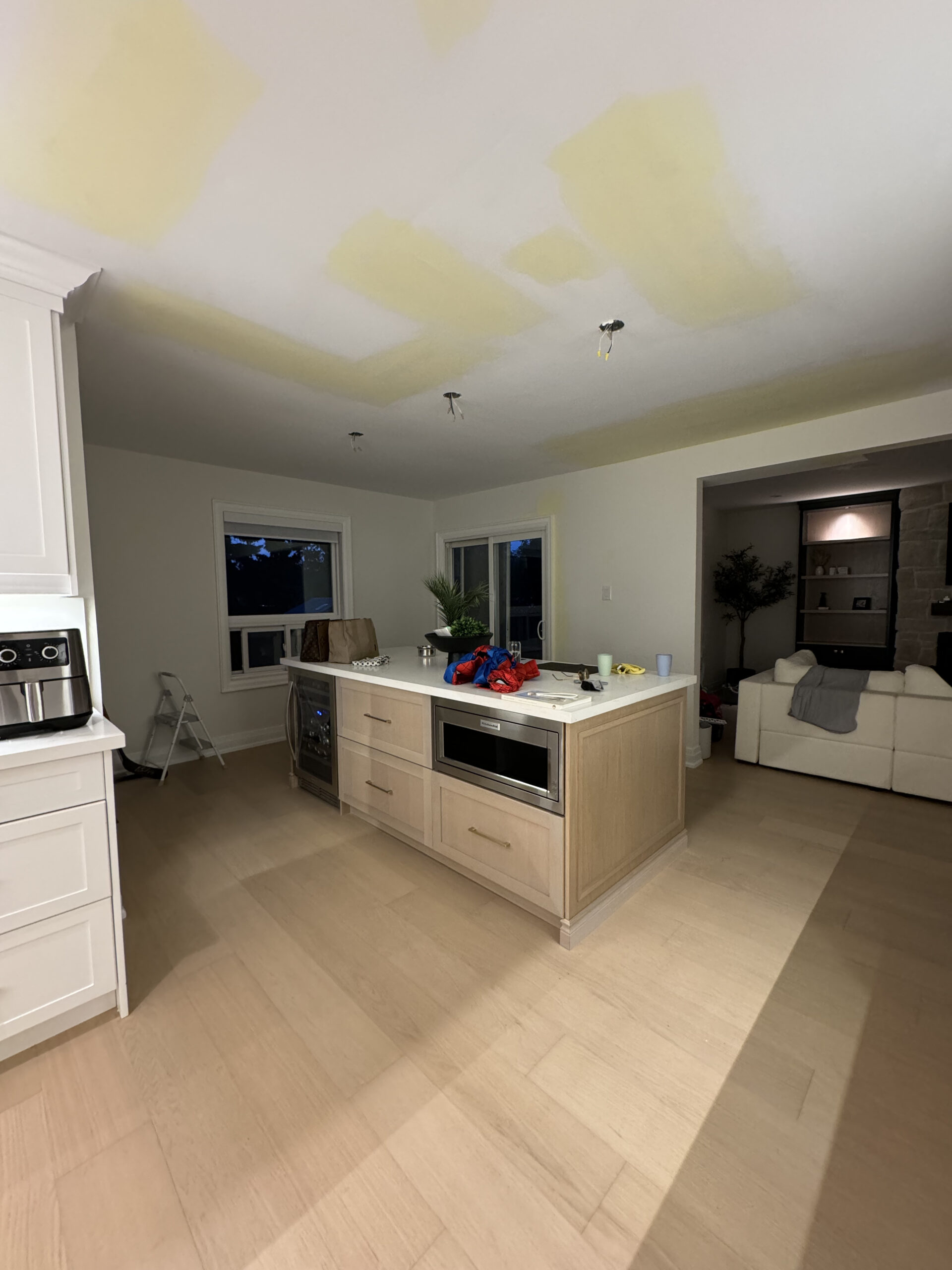
Most people arrive at this decision believing granite is the cheaper one and quartz is the upgrade. On today’s Toronto pricing that is no longer true - the two ranges overlap almost completely, and on a typical kitchen renovation the gap between a mid-range slab of each is usually under $1,000. So price is not the question. The questions that actually matter are whether anyone in your house will remember to seal a counter, and whether hot pans come off the burner onto it.
They are not the same kind of material
Granite is quarried. It comes out of the ground as a slab, gets cut and polished, and every piece is different — which is the whole appeal and also the reason you should never buy it off a sample chip.
Quartz is manufactured. Roughly 90% ground natural quartz mixed with polymer resin and pigment, pressed into slabs. That means consistency: the slab that arrives matches the one you approved, and two slabs from the same batch will match each other across a seam.
- Granite — natural stone, unique slab, porous, needs sealing, heat-resistant.
- Quartz — engineered stone, consistent pattern, non-porous, no sealing, not heat-resistant.
Almost every practical difference below comes out of that one distinction. Porous versus non-porous decides the maintenance. Natural versus resin-bound decides the heat tolerance. Unique versus manufactured decides how you have to shop for it.
What they actually cost in Toronto and the GTA
Installed, in a typical kitchen with 45–50 square feet of counter:
- Granite, common colours, straight polished edge — $60–$85 per sq ft installed.
- Granite, exotic slabs with heavy movement — $90–$110+ per sq ft installed.
- Quartz, entry-level domestic lines — $70–$90 per sq ft installed.
- Quartz, premium marble-look lines — $100–$120 per sq ft installed.
- Mitred thick-look edge (either material) — add $40–$70 per linear foot.
- Waterfall island end (either material) — add $800–$1,500.
The ranges overlap almost completely, which surprises people who still think of granite as the cheaper option. On a standard kitchen the difference between a mid-range granite and a mid-range quartz is usually under $1,000 — small enough that it should not decide anything. Spend the decision on maintenance and looks instead.
Maintenance is the real dividing line
Granite is porous. It gets sealed at install and re-sealed every 12–24 months, more often for lighter stones and hard-working kitchens. Sealing takes twenty minutes and costs almost nothing — the problem is that people forget, and the consequences show up as oil shadows near the range and rings where something acidic sat overnight.
Quartz is non-porous. Soap and water, indefinitely. No sealing, no special cleaners, and nothing soaks in. It is genuinely the lower-maintenance surface and that is not marketing.
Both resist scratches well in normal use. Neither should be cut on directly, though that is about protecting your knives more than the counter.
- Granite — seal on install, then every 12–24 months. Wipe spills promptly. Avoid acidic cleaners.
- Quartz — soap and water. No sealing, ever. Avoid bleach and abrasive pads.
- Both — use a cutting board, and on quartz always use a trivet.
If nobody in the house is going to remember to seal a counter, that answer is quartz and there is no point pretending otherwise.
Heat: the one thing granite does better
Granite formed under heat and pressure, so a hot pan set down on it does nothing. Quartz is bound with polymer resin, and resin is where it fails — a pan straight off a burner can leave a permanent white scorch mark or a thermal crack, and neither can be repaired. The slab gets replaced.
This matters more in some kitchens than others. If you cook seriously and pans regularly come off heat onto the counter, that is a real argument for granite, or for planning a landing zone: many of the kitchens we build get a small section of butcher block or a built-in trivet inset next to the range for exactly this reason.
- Granite — set a hot pan down directly, no damage.
- Quartz — trivet required. Scorching and thermal cracks are permanent and not repairable.
It is a genuine functional difference rather than a marketing one, and it is worth being honest with yourself about how you cook before choosing.
Shopping for them works differently
This is the part that catches people out. With quartz you can choose from a sample, because the pattern repeats and the slab will look like the chip. With granite you cannot — a 4-inch sample tells you the colour family and nothing about the movement, and a slab that looked calm in a photo can arrive with a dramatic vein straight through the middle of where your sink goes.
So with granite you go to the stone yard and put your hands on the actual slabs, and you tag the ones you want. Then, before fabrication, you approve a layout showing exactly where the sink cutout, the seams, and the veining fall on your slab. Skipping that step is how a beautiful stone ends up with its best feature cut out for a cooktop.
- Quartz — safe to select from a sample or a display board.
- Granite — see and tag the actual slabs at the yard, then approve a cutting layout.
- Both — confirm seam locations in writing before fabrication starts.
Seams are unavoidable on most kitchens — slabs are finite and islands are long. What is avoidable is a seam landing somewhere stupid, and that is a planning decision rather than a fabrication problem.
Where each one wins
Stripped of the sales pitch, the decision is fairly simple:
- Busy family kitchen, nobody will remember to seal anything — quartz.
- You want a light, quiet, consistent look, especially marble-look — quartz.
- Renovating to sell in the next year or two — quartz, on current GTA buyer taste.
- You cook hard and pans come off the burner onto the counter — granite.
- You want genuine natural stone with depth and movement no engineered surface copies — granite.
- Outdoor kitchen, or a sunroom counter in direct sun — granite. UV can discolour quartz resin over time.
- Bathroom vanity — either, and quartz is usually the better value at that size.
For a standard indoor Toronto kitchen, quartz is the lower-regret default. Granite is the right answer when you specifically want what granite is, not when you are trying to save money — because on today’s pricing, you mostly are not.
What we do on our own projects
Countertops are templated after the cabinets are set and levelled, never off drawings, because no wall in a Toronto house built before 1980 is straight. Fabrication then takes 7–10 days, and everything downstream waits on that slab — the sink drops into it, the faucet mounts through it, the backsplash sits on it.
That is why the counter is the last real step of a kitchen and why a mis-measure is the most expensive mistake on the job: it restarts the whole 7–10 day clock.
- Cabinets set and levelled, then the fabricator templates the real space.
- You approve seam and cutout placement before anything is cut.
- Fabrication 7–10 days, then install, then plumbing hook-up, then backsplash tile.
Counters, cabinetry, backsplash, sink and faucet all come through us on a kitchen build, so when a slab arrives with a flaw there is one party responsible for replacing it and no argument about whose problem it is.
People also ask
Is quartz or granite better for a Toronto kitchen?
How much do quartz countertops cost in Toronto?
How much does granite cost in Toronto?
Does granite need to be sealed?
Can you put a hot pan on quartz or granite?
Which is better for resale value in a Toronto home?
Next step
Planning a kitchen and still deciding on counters?
Reach out today for a free, no-pressure in-home estimate — and a clear, written project plan.