Kitchen Renovation Guide
Kitchen Cabinet Refacing vs Replacing vs Refinishing in Toronto: Which Cabinet Renovation Fits
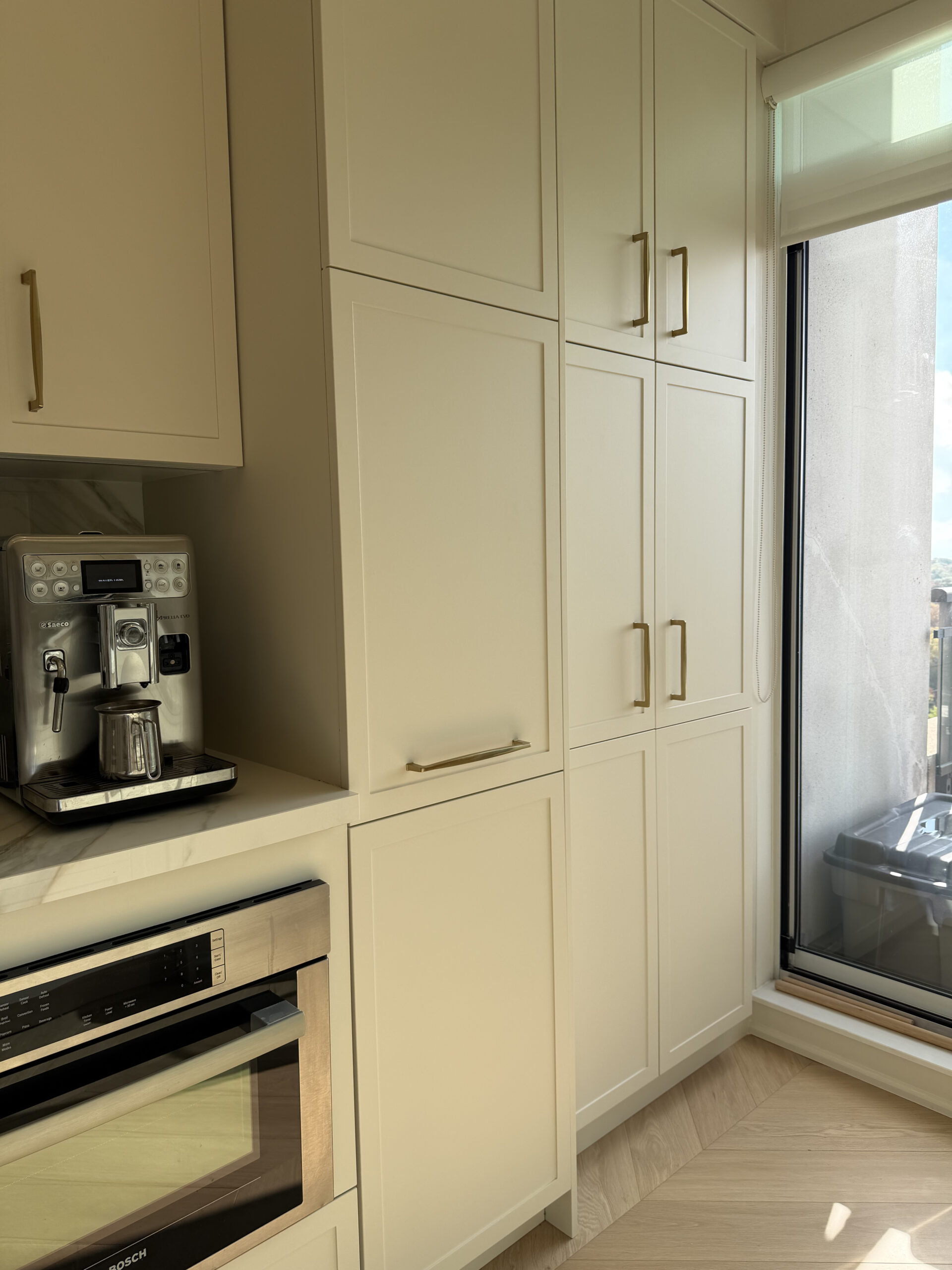
Your cabinets look tired. The question is whether the problem is the paint, the doors, or the boxes behind them. Each answer points to a different cabinet renovation, and the price gap between them is wide: painting a typical Toronto kitchen can cost a third of what new cabinets would.
This guide covers what refinishing, refacing, and replacing involve, how to tell if your boxes are worth keeping, and roughly what each costs in the GTA in 2026. If you are already leaning toward a full rebuild, our kitchen renovation cost guide breaks down the whole budget line by line.
Refinishing, refacing, and replacing: what each one is
Refinishing (cabinet painting)
Cabinet refinishing keeps everything you have and changes the surface. Doors and drawer fronts come off, get degreased, sanded, primed, and sprayed, usually off site. The boxes are painted in place. It works on solid wood and MDF. It does not work well on thermofoil or glossy laminate, which is what a lot of 1990s GTA builder kitchens have.
Refacing
Refacing keeps the cabinet boxes and replaces everything you see. New doors and drawer fronts go on, the exposed box faces and end panels get a matching veneer or laminate skin, and the hinges are swapped for concealed soft-close ones. The sink, the counters, and the plumbing stay where they are.
Replacing
Replacing means new boxes, new doors, new everything. In practice it is rarely just cabinets. Once the old boxes are out, the counters come with them, the flooring underneath is often unfinished, and it is the natural moment to fix the layout, lighting, and circuits. That is a kitchen renovation, not a cabinet job.
Side-by-side comparison
Costs are approximate for a typical 18–22 linear foot GTA kitchen in 2026, before HST. Your quote will depend on materials, access, and what we find once doors come off.
| Option | Approx. cost | Time | Keeps | Best when |
|---|---|---|---|---|
| Refinishing (painting) | $3,500–$7,000 | About 1 week | Boxes, doors, drawer fronts, counters, layout | Solid wood or MDF doors you still like the shape of, and a finish that is just tired or dated. |
| Refacing | $6,000–$12,000 | 1–2 weeks, kitchen usable | Boxes, counters, layout, plumbing | Sound plywood boxes, a layout that works, and quartz or stone counters you want to keep. |
| Replacing | $9,000–$16,000 for cabinets alone | Part of a 6–10 week kitchen renovation | Usually nothing but the room | Swollen or sagging boxes, a layout that does not work, or a kitchen that needs counters, flooring, and electrical anyway. |
When your cabinet boxes are worth keeping
Refinishing and refacing both bet on the boxes. If the boxes are bad, you are putting new doors on a failing structure. Four checks settle it.
- Box material. Plywood boxes are worth keeping almost regardless of age. Particleboard is fine where it is dry, but it does not recover once it has swollen.
- The sink base. Open it and press on the floor of the cabinet. Soft, bulging, or stained board means a past leak, and that box needs replacing at minimum.
- Square and level. Doors that will not line up, shelves that sag in the middle, or face frames pulling away from the wall all point to boxes that will not hold new doors straight.
- The layout. If you plan to move the sink, add an island, or take out a wall, the boxes are coming out anyway. Refacing them first is money spent twice.
We look at all four on the site visit and tell you straight whether your boxes are worth keeping. Some kitchens only need a new face. Plenty do not.
Approximate 2026 GTA costs
Contractors price cabinet work per linear foot of cabinet run, uppers and lowers together. These are approximate ranges we see across Toronto, Mississauga, and the rest of the GTA in 2026.
- Refinishing: roughly $150–$300 per linear foot, or about $3,500–$7,000 for a typical kitchen. Sprayed finishes and extensive grain filling on oak sit at the top of the range.
- Refacing: roughly $300–$550 per linear foot, or about $6,000–$12,000. Wood veneer and custom-sized slab doors cost more than laminate or stock Shaker.
- Replacing: semi-custom cabinetry alone runs about $9,000–$16,000, before counters, installation extras, and the other trades. A full kitchen renovation is typically $25,000–$50,000.
Replacing also brings costs the other two avoid: new countertops, often new flooring where the old cabinets sat, and plumbing and electrical reconnection. Those add up faster than the cabinet line itself.
How long each option takes
Refinishing takes about a week. Doors go to the spray booth, the boxes get painted in place, and everything goes back on once cured. Expect a few days of limited use.
Refacing takes 1–2 weeks on site, after the doors are made. The kitchen stays usable through most of it because the sink, counters, and appliances never move.
Replacing happens inside a full renovation, which typically runs 6–10 weeks of construction. Semi-custom cabinetry also has a 6–10 week lead time from final measure, so the order goes in well before demolition.
Hinges, drawers, and hardware upgrades
Most of the daily annoyance in an old kitchen is mechanical, not visual. Doors that bang, drawers that stick, runners that drop off their track. All three options can fix some of that.
- Concealed soft-close hinges. Standard on refacing and replacing. Possible on a refinish too if the doors are drilled for cup hinges.
- Full-extension undermount drawer runners. Blum and Hettich are the two we use most. On a reface, this means new drawer boxes sized to the existing openings.
- Converting base doors to drawers. Easy on new cabinets. On existing boxes it depends on the face frame and the box depth, so it is a site-visit question.
- Pulls and knobs. Matte black and brushed brass are still the two finishes people ask for in 2026. New hardware on a refinish often needs old holes filled first.
What happens to your countertops
This is often the deciding factor. Replacing the cabinets almost always means new counters. Stone has to be lifted to get the boxes out, and quartz and granite slabs crack at sink and cooktop cut-outs during removal more often than people expect.
Refacing and refinishing leave the counter where it is. If you put in quartz a few years ago and still like it, keeping it is a real saving of several thousand dollars. If you are choosing a new surface anyway, our quartz vs granite comparison covers durability and 2026 Toronto pricing.
Door styles people are choosing in 2026
New doors are where refacing and replacing earn their cost, so it helps to know what you want. These are the requests we see most often, not predictions.
- Slab or flat-panel doors. Clean in a condo or a modern rebuild. They show every chip, so a durable finish matters more than with Shaker.
- Narrow Shaker. A thinner rail than the classic 2.5-inch frame, which reads as current without going fully flat.
- Two-tone kitchens. A darker or wood-grain lower run with lighter uppers, or a contrasting island. It works best when the two colours are close in warmth.
- Wood-grain veneers. Rift oak and walnut looks are back after a long run of all-white kitchens.
- Integrated pulls and finger grooves. No hardware on the face at all. Good on slab doors, awkward to retrofit on a refinish.
For layouts and finishes beyond the cabinets, see our kitchen renovation ideas for Toronto homes.
People also ask
Is refacing kitchen cabinets worth it in Toronto?
Can you paint laminate or thermofoil cabinet doors?
Can I keep my quartz countertops if I replace the cabinets?
How do I know if my cabinet boxes are plywood or particleboard?
Does refacing include new drawers and hinges?
Keep planning
Next step
Not sure if your cabinet boxes are worth keeping?
Reach out today for a free, no-pressure in-home estimate — and a clear, written project plan.